
Farming lobby's private pitch to weaken EU pesticide rules
Leading agriculture and pesticide groups invited EU policymakers to a closed-door briefing on relaxing pesticide approval rules. We have the presentations.

This summer, EU policymakers were invited to the offices of Copa Cogeca, the most influential agriculture group in Europe, for a closed-door briefing about relaxing Europe's pesticide approval regime.
The "Farmers' Toolbox" event, co-hosted by pesticide association CropLife Europe, saw industry representatives present a wishlist for the Food and Feed Safety Omnibus, a package of laws to rewrite food and farming rules currently making its way through the Parliament.
Right now, before a pesticide can be sold, its active ingredient (glyphosate, for example, is the active ingredient in the Roundup weedkiller) needs approval at the EU level, and gets reassessed every 10-15 years to check it's still safe. National governments can also introduce their own extra restrictions.
The Commission already wants to loosen part of that system: under its proposed reforms, most pesticide approvals would no longer expire, they'd run indefinitely unless new evidence of harm turned up. At the event, industry pushed MEPs to go further still.
Documents obtained by GRILLED show Copa Cogeca calling for a measure that would prevent member states from banning pesticides already approved elsewhere in the EU. German farming association Deutscher Bauern Verband (DBV) made the case for revisiting the bloc's ban on bee-killing neonicotinoids.
"By teaming up with the pesticide lobby in this push for deregulation," Nina Holland, agribusiness researcher at the NGO Corporate Europe Observatory, told GRILLED, "farmer lobby Copa Cogeca and its member DBV are scoring an own-goal for farmers on the ground."
Pesticide presentations | the birds and the bees
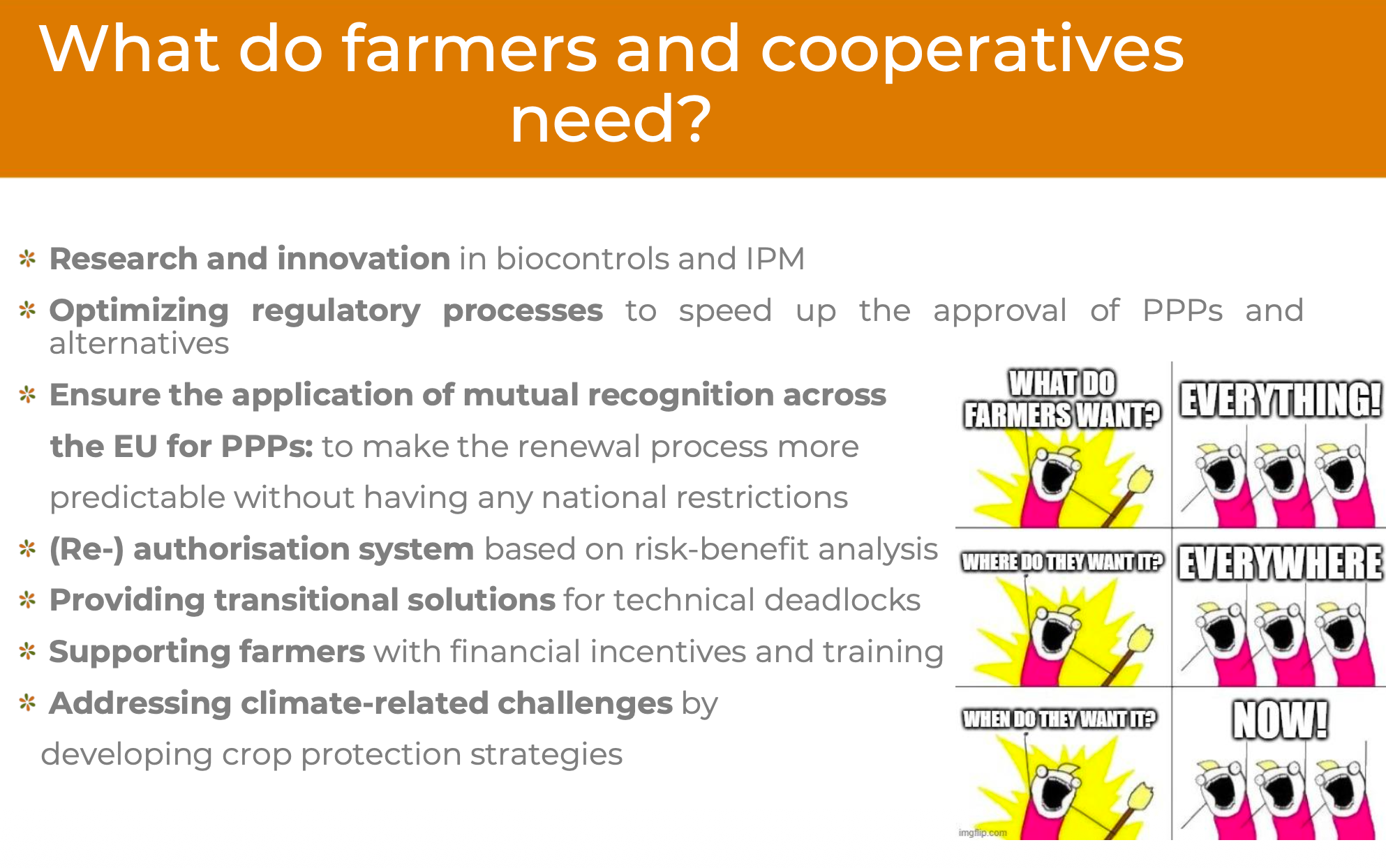
Copa Cogeca's presentation set out its guiding principle as "No ban without alternatives," warning of a decline in available pesticides, a lack of replacements, and a slow approval process for new products. The group also linked climate change to new pests and greater disease pressure.
It took aim at a rule called mutual recognition, which lets a pesticide approved in one EU country be used in another without a fresh national check. Copa Cogeca wants that rule to apply across the whole bloc, "without having any national restrictions," in effect making it much harder for any single country to keep a pesticide off its own market once it's approved anywhere in the EU.
Copa Cogeca did not respond to requests for comment.
CropLife Europe’s presentation referenced an unpublished "Agronomic Impact Report" it had written, which examined the impacts of pesticide restrictions on several major EU crops. CropLife members have separately called for that mutual recognition process to become automatic, according to a document seen by GRILLED.
A CropLife Europe spokesperson said mutual recognition "does not in itself remove" member states' rights to refuse, amend or withdraw pesticide authorisations in their own territory, and that the group supports the principle "as a means of improving consistency between Member States... and improving the functioning of the Single Market," while "not advocating the removal of safeguards available to Member States under EU law."
Salomé Roynel, a policy officer at Pesticide Action Network Europe, said that protection only holds if recognition stays a case-by-case process. Making it automatic, she said, "would strip Member States of their obligation to independently scrutinise the latest science and reject a product where the evidence shows unacceptable risks to human health or the environment."
Asked directly whether it backed Copa Cogeca's call for approvals "without national restrictions," CropLife said it viewed the question as "part of a broader technical discussion," and that mutual recognition should "operate as intended under the existing legislative framework.”
DBV, Germany's biggest farming union, also presented at the event. It pointed to falling oilseed rape yields as evidence the EU's neonicotinoid restrictions had backfired, arguing that "losing the neonicotinoids reopened pest routes that measurably cut yield, distinct from the weather." The group said the ban, "meant to protect bees," had instead seen "the rapeseed area then collapse, leaving fewer flowering crops," as farmers shifted to pyrethroid insecticides it says are more harmful to bees.
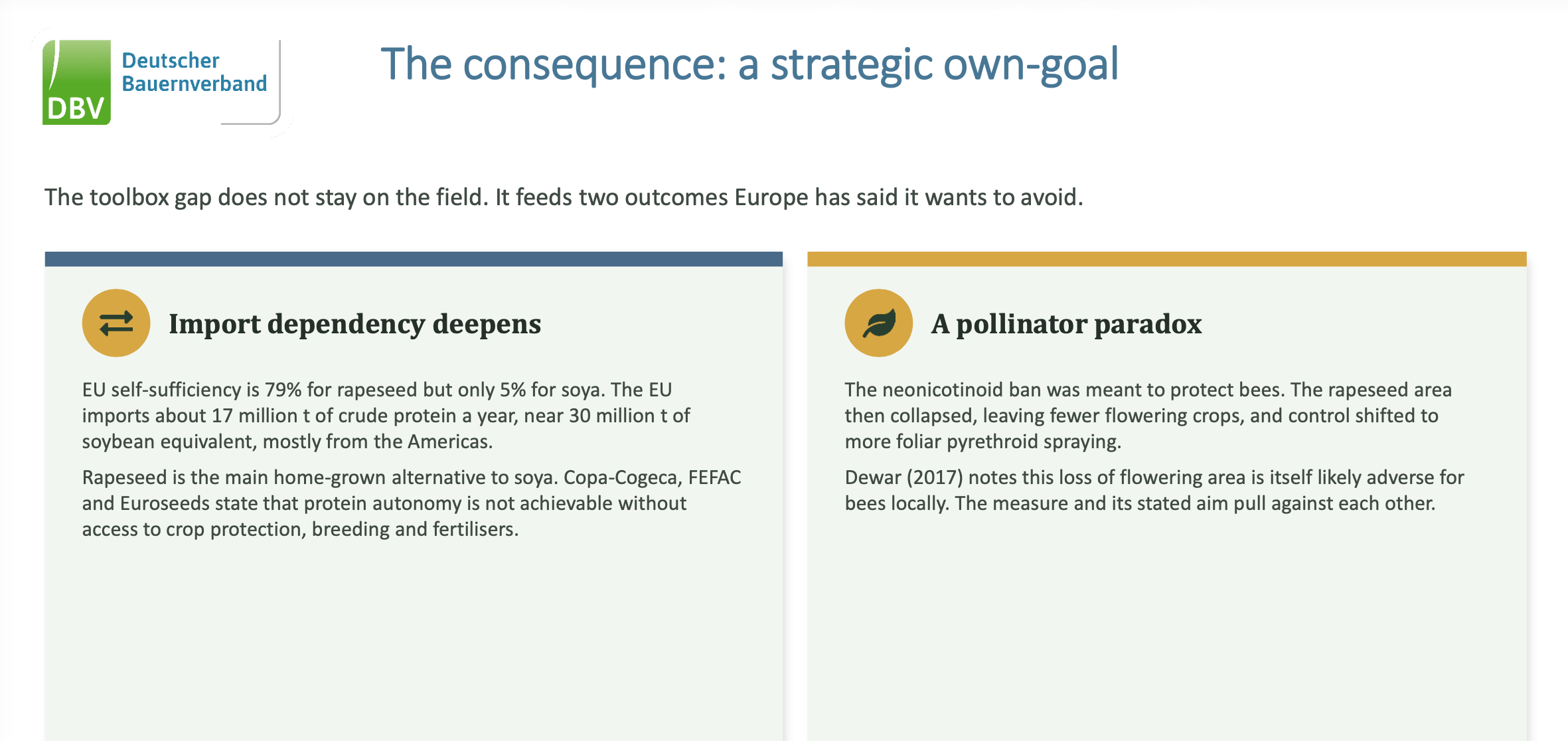
Asking whether the restrictions were "spilled milk or something to learn from," DBV called for an assessment of whether the ban had actually achieved its goal: "If neonicotinoids are banned on precautionary grounds, the same precaution demands measuring whether pollinators actually benefit and whether the shift to foliar pyrethroids merely redistributes the harm."
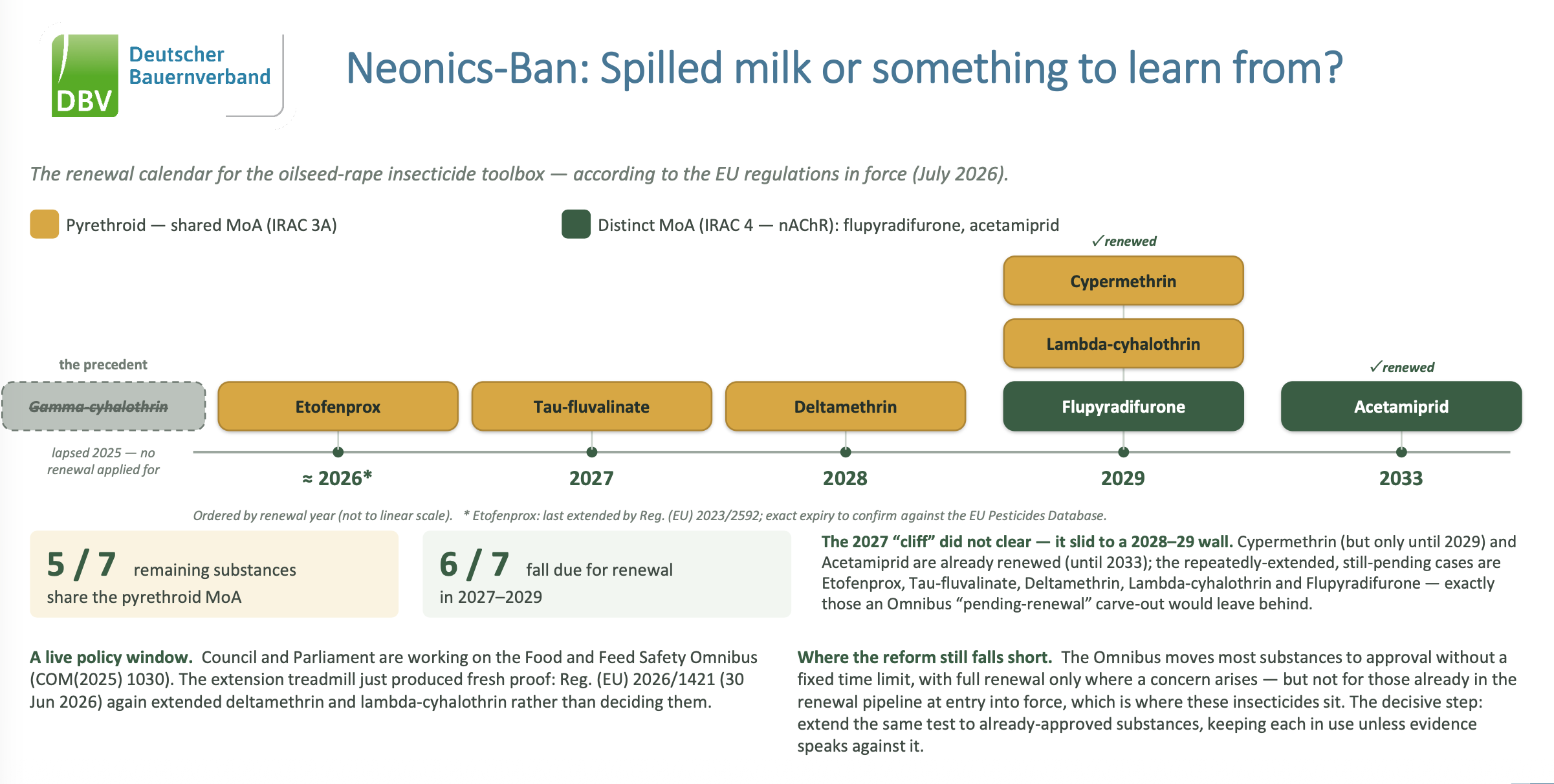
The group also urged policymakers to extend the Omnibus's open-ended approval standard to the pesticides that replaced the banned neonics, many of which are currently going through the EU's renewal process. "Renew an already-approved substance unless there is evidence against it, which is exactly where rapeseed insecticides sit," the presentation says. "Renew on risk, not hazard alone."
In a statement to GRILLED, DBV said it is not calling for the banned neonicotinoids to return: "What the presentation does not contain is a call to bring back the restricted substances. That demand is not on any slide, and it was not made in the room." Instead, the group said, it wants "an official assessment of whether the restriction achieved what it was adopted to achieve". This request, DBV’s representative concluded, is "uncomfortable only if the answer is in doubt."
The industry’s arguments were echoed at a European Parliament hearing on the Omnibus earlier this month. Anne-Kathrin Mahlein, director of Germany's Institute of Sugar Beet Research, told MEPs a "dramatic decline" in approved pesticides since 2019 had made pest resistance management "nearly impossible" for some crops. Campaigners criticised the hearing's panel for lacking independent scientific expertise.
Nina Holland, of Corporate Europe Observatory, told GRILLED: "The attempts made now to keep harmful insecticides on the market, or bring back the old neonicotinoids, are a true scandal. Insects are declining massively, and farmers depend on them to pollinate their crops, our food."