
Chicken welfare pledge used as a licence for new factory farms
Planning applications across the country are invoking the Better Chicken Commitment as justification for new and larger factory farms
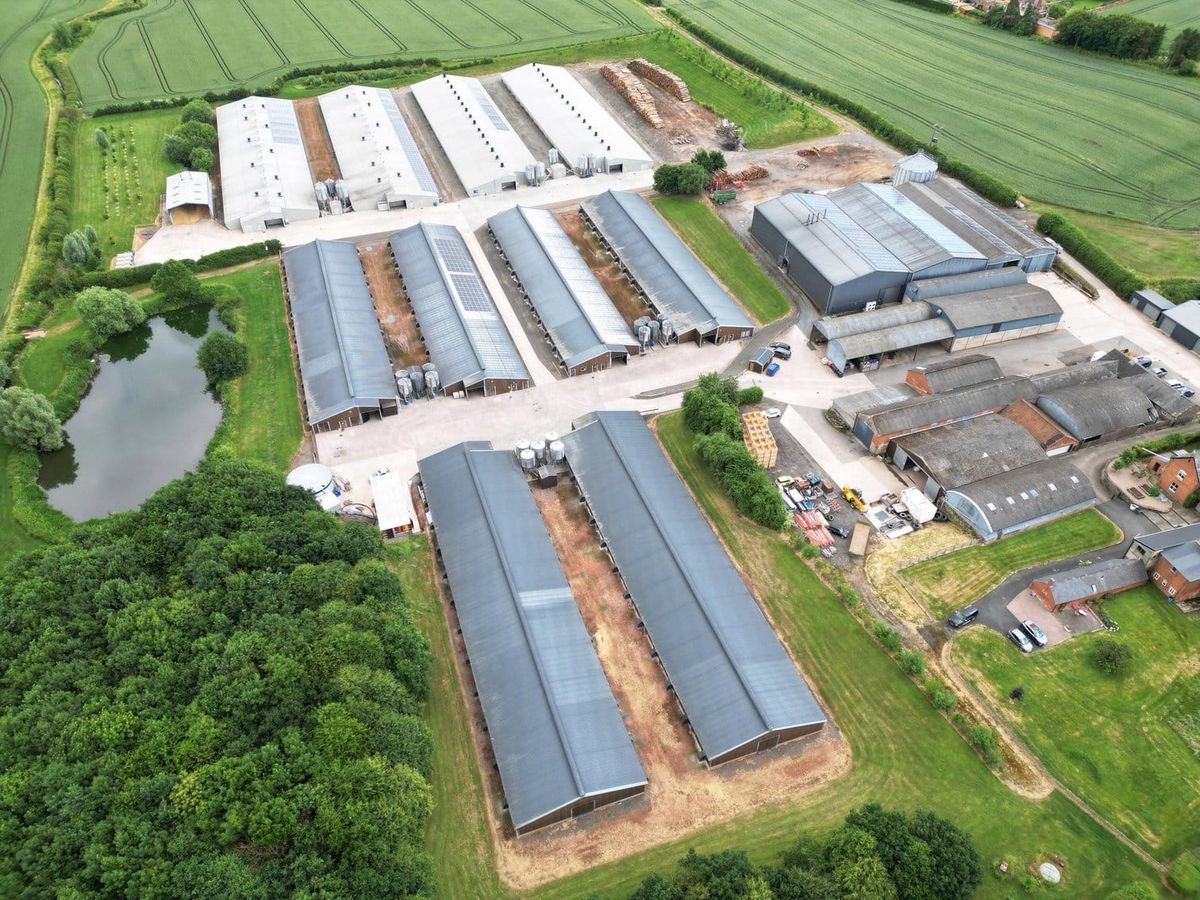
Photo: Alamy
The British poultry industry is planning to build at least 600 new chicken sheds in response to new supermarket welfare standards, an investigation by GRILLED and The i newspaper has found.
Producers argue the Better Chicken Commitment and lower stocking density goals mean many more farms are needed just to keep production stable.
But analysis of planning registers has identified 14 proposals making this argument in support of new or larger factory farms that together would increase production capacity by 2.3 million birds and slaughter nearly 17 million more chickens a year.
Harrison Pick, a consultancy from East Yorkshire described in the trade press as “planning royalty”, filed the vast majority of the applications identified.
Across multiple proposals submitted to different councils for different clients - from Lincolnshire to Shropshire to Norfolk - the company used identical justification text, including a recurring grammatical error.
“The major implication of this commitment is that 21% more poultry houses are required in order to continue production are current levels, with no expansion of the industry. It is now of strategic importance for UK food security that more poultry houses are developed to enable the adoption of the higher welfare standard, without creating a major shortage of chicken which will otherwise be filled by imports of chicken from abroad which are produced under lower standards of animal welfare”
One application, for a development in Telford, goes further, estimating that the welfare shift means the industry needs to build around 600 new poultry units and add 24 million new bird places nationally.
Harrison Pick said the similar language across applications was appropriate because “the underlying market driver is the same across all these applications — the adoption of lower stocking density requirements is a sector-wide policy shift, not a site-specific circumstance.”
The company said new shed capacity was “required simply to maintain equivalent output at the new welfare standard” and that it was “factually accurate to reference these commitments as the material driver of demand for new facilities.”
It did not address the fact that the applications it prepared state explicitly that proposed developments would increase bird numbers at each site.
“Better Chicken”
The welfare commitment invoked is the Better Chicken Commitment, a voluntary pledge that requires producers to reduce stocking density from 38 to 30 kilograms per square metre, which is roughly the difference between 17 and 14 chickens in an area equivalent to a coffee table.
Waitrose and Marks & Spencer are formal signatories. Tesco, Sainsbury’s and most other major retailers have committed to lower stocking density but have not signed the BCC over its demand to switch from fast-growing breeds, otherwise known as frankenchickens.
Restaurant chains including Nando’s and KFC previously signed the pledge, but withdrew earlier this year over the same fast-growing breed demand.
The commitment is voluntary and carries no enforcement mechanism. Once a farm is built, there is no way to ensure the welfare standards that justified its construction are actually maintained.
The Better Chicken Commitment was developed by a coalition of animal welfare organisations including Compassion in World Farming and The Humane League, who have spent years pressuring retailers to improve conditions for broiler chickens. They argue that lower stocking density alone is not sufficient without a shift to slower-growing breeds.
Anthony Field, Head of Compassion in World Farming UK, said: “Some planning applications use the Better Chicken Commitment as a reason for more sheds, while the companies behind the applications fail to commit to delivering on all the BCC welfare requirements. Fast-growing chickens are bred to gain weight so quickly that many can barely walk by the end of their short lives, leaving them unable to benefit from the extra space. Better welfare requires better birds, not just bigger sheds.”
Cordelia Britton, Head of Programs at The Humane League UK, said: “To use animal welfare as an excuse to expand the industry in a country which slaughters over a billion chickens a year is the wrong approach. There is a tantalising diversity of plant-based proteins that companies should be investing in.”
Changing the planning rules
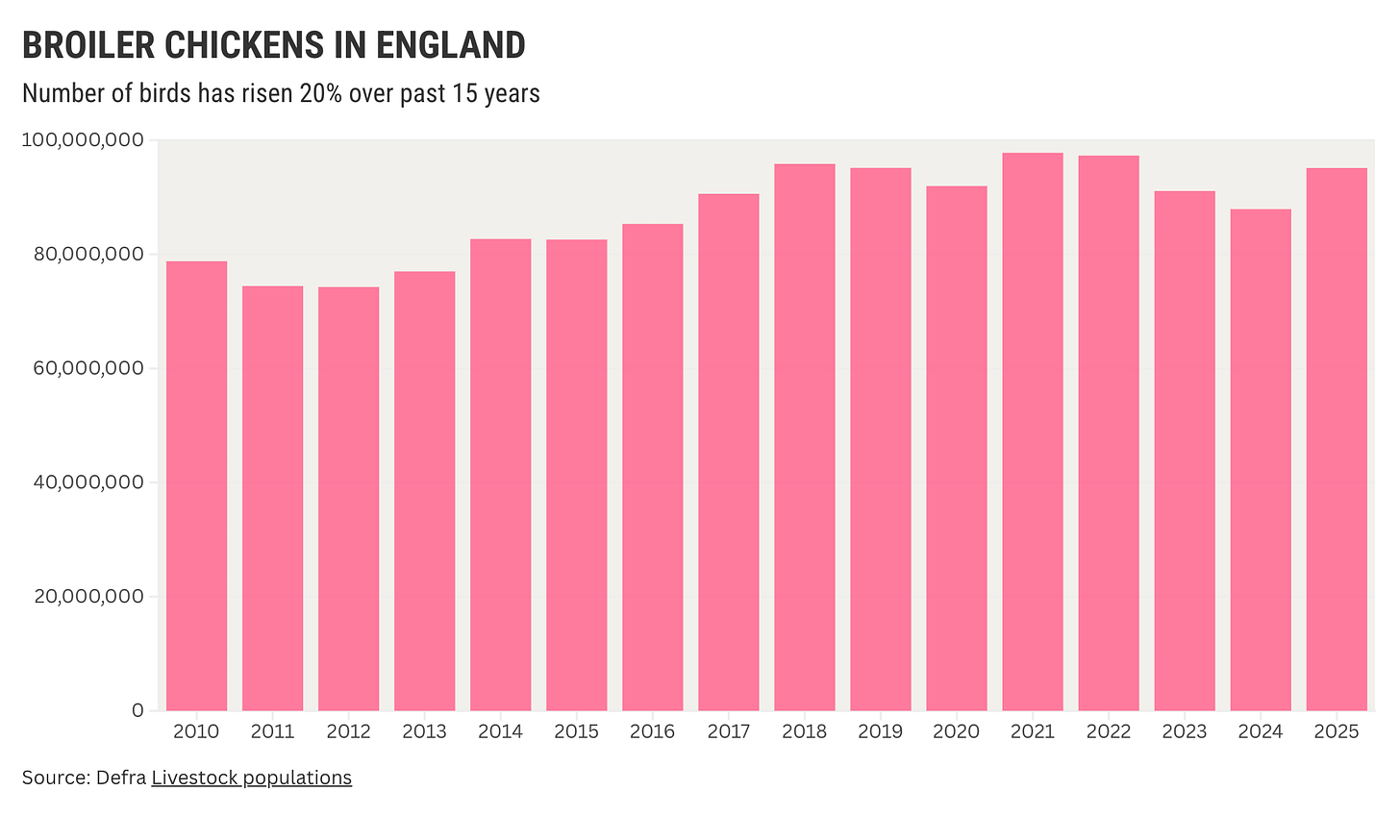
Though the poultry industry routinely complains over difficulties navigating the planning process, official data shows broiler numbers in England rose 8.2% last year, and chicken production has grown by 20% since 2010.
The British Poultry Council said consumer demand for chicken had risen around 4.5% in the last year alone and that “the sector will need to expand by 3% year-on-year to catch up with and meet the growing demand,” adding that “growth and welfare improvements are not contradictory.”
At the British Pig and Poultry Fair in May, Avara Foods, one of the country’s biggest chicken producers and owned by American agricultural giant Cargill, told producers the industry needed to lobby government to create a national planning framework that would “take the decision away from local planning officers.”
Earlier this year, GRILLED revealed that the government was considering changes to planning rules that would make it harder for councils to block intensive poultry developments. The changes came after intensive lobbying by the British Poultry Council, with internal government notes linking the reforms directly to industry pressure.
Jen Davey, whose parents own an organic farm next to one of the applications in Wragby, Lincolnshire, said the development would be part of a cluster of four or five intensive poultry units within five miles. “It’s not in any way, shape or form what anyone would think of as farming,” she said. “It’s industrial, it’s a factory, everything about it is industrialised.”
Ruth Westcott, Campaign Manager at Sustain, said: “Chicken companies are trying to sell a story of ‘higher welfare’ to win over the public and politicians but it doesn’t change the fact that keeping hundreds of thousands of birds in indoor units up and down the country is a major and growing source of pollution. It is contaminating our rivers and air quality and harming rural communities.”
The British Poultry Council said all poultry farms housing over 40,000 birds were subject to environmental permitting regulations, adding that “linking them to river pollution is fallacious.” It said the planning system “lacks any government oversight for food production, leaving local authorities to make decisions on complex applications on a case-by-case basis with no national support.”
A Defra spokesperson said: “We welcome the shift from some poultry farmers’ towards lower stocking density and wider efforts to reduce reliance on fast growing breeds.
“We understand these factors drive a need for more poultry sheds and we are working closely with industry to manage the risks to the environment and local communities.”
The 14 applications identified span councils across Lincolnshire, Norfolk, Shropshire and Staffordshire. Twelve remain undecided.
A version of this story ran in The i newspaper