
Data: Meat plants use more water than the population of Brighton
As meat processors demand priority access to water during drought, exclusive data reveals the industry's water use
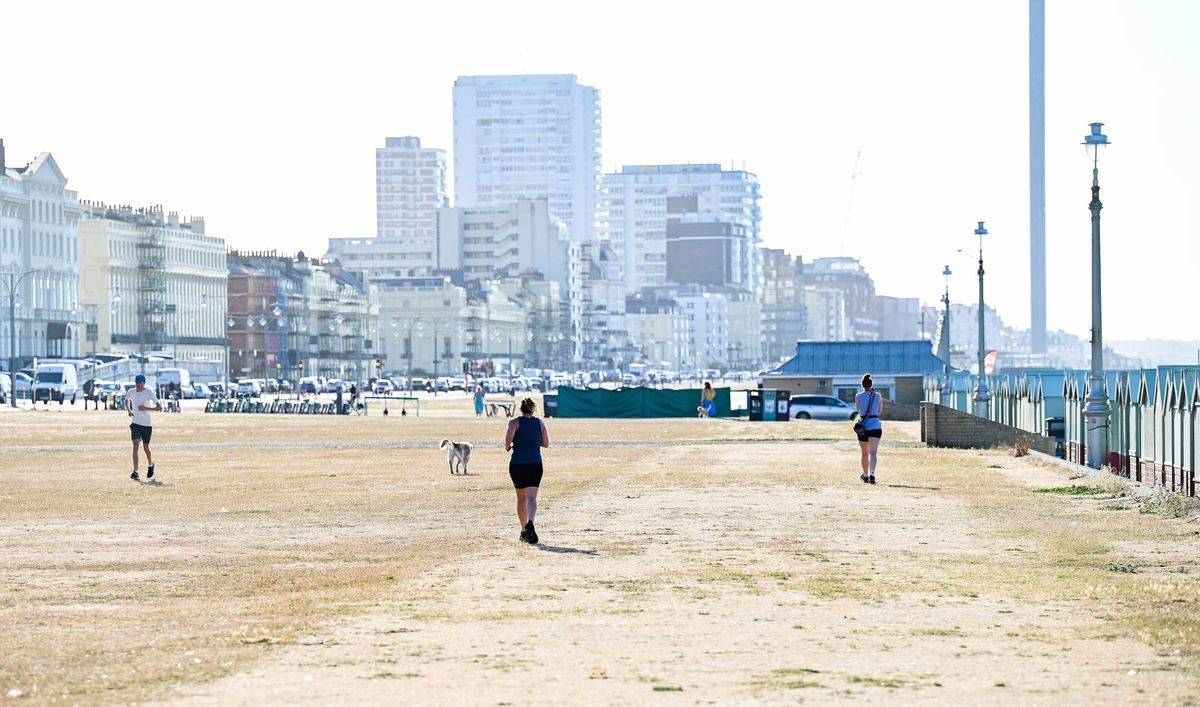
Brighton in drought | Photo: Simon Dack News
On July 15, in the middle of England’s driest July on record, a large poultry processing plant in Devon shut down for two days due to water constraints. Having already cut use by almost 30%, the plant's operator, 2 Sisters, warned that further restrictions would "create a serious and immediate animal welfare risk".
Off the back of that event, the British Meat Processors Association (BMPA) called for processing sites to have "continuous access to water, irrespective of wider pressures on local supplies". Water companies are currently required by law to prioritise households over businesses during shortages. The request remains unresolved.
This push highlights the water intensity of the meat processing sector, with new figures obtained by GRILLED showing that annual water use by England's meat plants exceeds 14.1 billion litres, or 38.8 million litres per day.
That means England's meat processors use as much water as 285,000 people. If it were a city, the industry would be England's 13th largest, thirstier than Brighton and Hove.
Most of that water is used for cleaning, such as washing down equipment and carcasses, with much of it required under food safety rules.
The data, produced by the Environment Agency (EA) for the year 2025 and obtained using environmental information rules, covers 84 slaughterhouses and meat processing plants. A further twelve operating facilities did not provide the EA with water use figures for the year so the figure is certainly higher.
Swathes of England suffered drought conditions in 2025, including Cumbria and Lancashire, Yorkshire, and both the East and West Midlands. Much of the rest of the country experienced 'prolonged dry weather'. Water stress this summer just past was even more severe, with nearly three-quarters of England still in drought by mid-September.
Poultry is the largest water user in the meat processing sector, with 24 plants representing 60% of the industry's total.
The region of the country where processors used the most water is East Anglia, where meat plants used 4.1 billion litres, almost 30% of the industry’s national total, almost three-quarters of it at poultry plants. The region has been in drought this year, and Essex & Suffolk Water brought in its first hosepipe ban since 1997.
Water use is also concentrated among a handful of companies. Pilgrim's Europe, which owns Moy Park and is part of JBS, the world’s biggest meat company, accounted for 17.5% of the total across its chicken and pork sites. It is followed by 2 Sisters (13.9%) and Cranswick (9.5%), which processes both pigs and poultry. Together, the three companies used around 41% of the meat processing sector’s water. The biggest single site, Moy Park's chicken plant at Anwick in Lincolnshire, used 1.1 billion litres.
Around a quarter of the water, roughly 3.7 billion litres, wasn’t taken from public supplies; it was drawn from the plants' own boreholes and direct abstraction from rivers and groundwater. That means it isn't subject to the hosepipe bans imposed on households.
In late July, water minister Emma Hardy asked Defra, the National Farmers' Union and water companies to explore water resilience measures, including a prospective "livestock register" of vulnerable businesses. No decision has been announced. Food processors are not eligible for a £65m drought package unveiled in August focused on supporting farmers and on-farm reservoirs.
"Across England, families face hosepipe bans and farmers are needing to cut back on irrigating crops, with drought expected well into next year," said Ruth Westcott, director of campaigns at Foodrise. "The water used by just part of the meat processing industry is shocking, and is only the tip of the iceberg… We must stop the reckless expansion of industrial meat and build a food system that both prevents climate change and is resilient to it."
Used but not lost
"The volume of water used by the meat processing industry is large, but needs to be put into context," Tim Hess, emeritus professor of water and food systems at Cranfield University, told GRILLED.
Most of the water used in meat processing is non-consumptive, meaning after use it is treated and returned to the environment, with only a proportion of the total actually "lost". In contrast, Hess said, irrigation of potato crops uses around four times as much water as meat processing and most of it is consumed.
"All food production and processing uses water and there is a trade-off between the local impacts of water use on other water users and the benefits of food production," Hess continued. "In some situations, a single meat processing facility may have a significant local impact, and businesses should be encouraged to employ water efficiency measures to reduce the impacts."
Meat plants use nearly six times as much water as the UK’s data centres, according to Water UK estimates, but most data centre water is consumed, evaporating during cooling.
These figures only cover processing, however. They do not include water used on livestock farms or for the crops that feed the animals. The meat industry’s total water use is higher still.
The British Poultry Council and British Meat Processors Association did not respond to requests for comment. The Environment Agency had not commented by the time of publication.
Methodology
Water use figures were supplied by the Environment Agency in cubic metres for 2025 and converted to litres (1 m³ = 1,000 litres). The figures cover permitted installations that reported total water use for 2025; one site's figure is still being confirmed with the EA. Population equivalents use Water UK's estimate of average household use of 136 litres per person per day. City comparisons use ONS Census 2021 built-up area populations. The figures cover processing plants only, not water used on farms.